

What relationship do you have (or have you had) with your failures?
I started this article with this question because I was last week at a seminar organized by AIF Lazio – Associazione Italiana Formatori and led by Fulvio Sperduto, founder of Talento Dinamico, a training and consulting company, and president of AIF Lombardia. The theme, precisely, was The Magical Power of Failure, the title of a book by Charles Pépin, a French philosopher.
Why do I want to talk about it? Because I had already read the book, which I found enlightening both personally and professionally.
From a personal point of view, it helped me to look at my failures again, yes, but from a different perspective, helping me to have the honesty to call them by their names more and better than I had done so far; from a professional point of view because of the way the topic of failure is treated from various points of view: philosophical, historical, psychological and dare I say even anthropological and sociological, but with two basic characteristics: concreteness and simplicity, which, in my opinion, for those who, like me, are involved in education are fundamental characteristics.
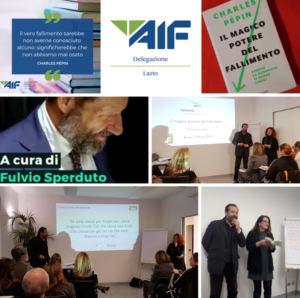 And it is the same concreteness and simplicity that I appreciated about the seminar: it was not a presentation of the book and/or its themes, but a real experience for the participants, the kind of experience that gives meaning to the term training, which etymologically means shaping something, in this case, a new awareness about oneself and one’s relationship to one’s failures, helping people learn rather than teaching them something, borrowing Sir John Withmore’s words about coaching. For that matter, long before, in the words of Socrates we find:
“The mediocre teacher narrates. The good teacher explains.
The excellent teacher demonstrates. The teacher inspires.”
and, I would add, generates new questions, new awareness and transformation.
But if we are talking about failure what does success have to do with it?
Because in the true success stories of real people success and failure from antithetical, different, in conflict … are actually “almost friends,” necessary and complementary to each other. In this view, therefore, failure paradoxically becomes a necessary step in achieving success. More than friends … real allies, where one without the other do not exist and do not subsist. Indeed, real success stories of real people have precisely this in common: they are the result and consequence of stories of failures that preceded success.
So. where is the difference that makes the difference?
The difference really lies in how we look at, how we experience failure. How willing we are to question ourselves, to learn, get back up and correct our course. And it occurs to me to add, how motivated we are to want to make it a learning opportunity, to be able to grit our teeth, pick ourselves up and move on.
Yes, because motivation plays a key role. In previous articles I have talked about theimportance of the Big Why in each of us and curiosity to succeed. Viktor Frankl in The Man in Search of Meaning said that “man’s main concern is not to achieve pleasure or avoid suffering but rather to give meaning to his life.” Mutatis mutandis … I say that no human being needs success at all costs, that is what we have been made to believe, but a strong and deep meaning, a strong and deep meaning that generates motivation indeed, even better, self-motivation.
And it is precisely this sense, this meaning, thisself-motivation that ignites, reignites or keeps our spark lit, that gives us a good reason and the strength to move forward, to make new attempts to progress each day, adding a little piece to our puzzle… willing to go through the chaos to give birth to our dancing star, to simply become who we are and the extraordinary person we are meant to be .
Having written a life coaching book on the topic, Destination Yourself, and being in the profession of training and coaching, I am naturally sensitive and fond of the topic. That is why during the seminar, when we were asked to choose a sentence or page from Pépin’s book, I chose this one:
“When you play a note,
only the next one will allow you to tell
whether it was right or wrong.”
Miles Davis used it with his musicians when they feared making mistakes; it is related to the time factor, to learning NOT to stop the music on the “wrong note” without giving it a chance to take its place in the music and in history as it develops.
Because as Walt Disney said:
“You may not realize it when it’s happening,
but getting kicked in the teeth might be
the best thing in the world.”
This is not to say that in the face of failure we break out the champagne. Falling down hurts. Boy, does it hurt! And it’s okay to get angry, to be disappointed, to experience the down phase…. it’s what you choose to make happen next that makes the difference.
Thank you
Emanuela
You may also be interested in
All articles
Loneliness in the Age of Communities
Mother Teresa called loneliness the most terrible poverty, associating it with the feeling of…

Doctor-patient relationship: the placebo effect of communication
I start with a quote from Prof. Fabrizio Benedetti, professor of neuroscience at the…
Feedback: when the sandwich becomes an omelet
How many times have you heard about how important feedback is? And how crucial…